Last updated 2026-08-19
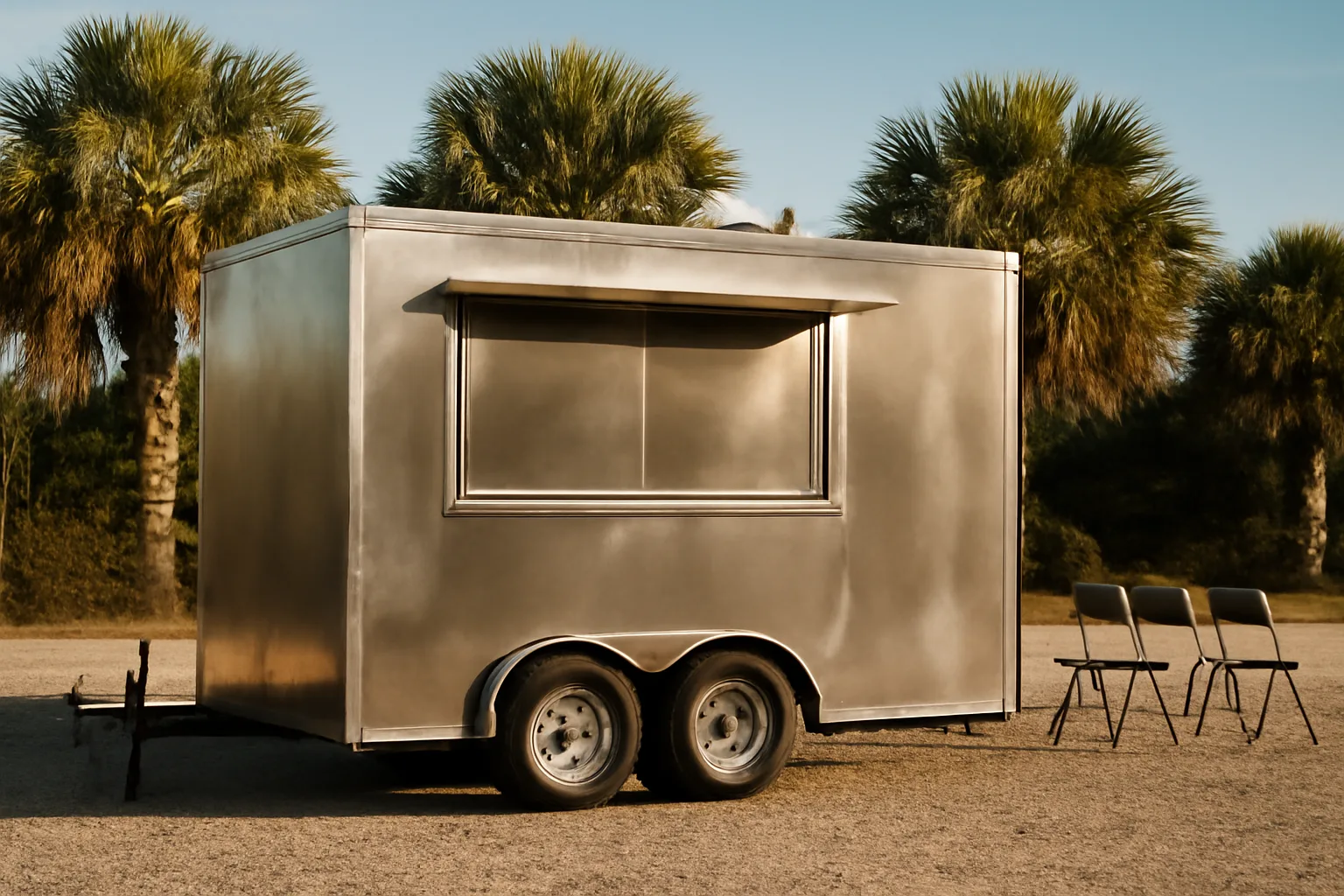
TL;DR
A concession trailer in Florida usually costs $20,000 to $120,000 for the unit, then sales tax, a DBPR mobile food license, plan review, and entity filings. Florida Statute 509.102 blocks most local food-truck permits. There is no published timeline guarantee. Confirm fees and review time with DBPR and your county tax collector before you wire a builder.
How much does a concession trailer cost in Florida?
A working concession trailer in Florida usually costs $20,000 to $45,000 used and $55,000 to $130,000 new, before tax, the tow vehicle, and licenses. That band comes from builder quotes and public listings, not a state price list. Florida does not publish an official trailer price.
Cheap 7x12 or 8x12 boxes with one fryer show up under $25,000. Many of them fail a first plan review. Full 8x16 and 8x18 kitchens with a three-compartment sink, a hand sink, enough refrigeration, and a hood land higher. Custom 8x20 and 8x24 units with a generator and extra prep often break $100,000 before you hitch them.
The unit is the big check. It is not the only check. You still pay Florida sales tax on the purchase, a state food service license, plan review, entity filings, and (if the unit is not truly self-sufficient) commissary access. A national food-truck average is the wrong yardstick. Those averages blend trucks, trailers, and cities that never faced Florida's license preemption.
Convert a cargo trailer and the steel box looks cheap. The sinks, water heater, tanks, NSF equipment, finishes, and hood are what inspectors look at. Budget the conversion like a kitchen, not like a weekend fab project.
Nobody keeps a clean public dataset of winning bids. Treat any single social post as marketing. Get three written quotes that list equipment by make, tank sizes, and whether the builder hands you the drawing set DBPR wants.
Do you need a license for a concession trailer in Florida?
Yes. A concession trailer that prepares or serves food in Florida is a public food service establishment, and it needs a license from the Division of Hotels and Restaurants at the Department of Business and Professional Regulation. Florida Statute 509.241 says each public food service establishment "shall obtain a license from the division." [2]
Florida Statute 509.013 is the definition section that pulls mobile food dispensing vehicles into that licensing world. [1] You apply as a mobile food dispensing vehicle (MFDV), not as a seated restaurant. Plan review usually comes first on a new or out-of-state unit. Confirm the current packet on DBPR's plan review page. [12]
What you generally do not need is a second city or county food-truck permit just to exist. Florida Statute 509.102 preempts local licenses, registrations, permits, and fees for MFDVs. The statute says a municipality, county, or other local governmental entity "may not require a separate license, registration, or permit other than the license required under s. 509.241." [3]
That is not a free pass to park anywhere. Property owners still say yes or no. Event organizers still set vendor rules. Locals still run parks, beaches, and rights-of-way. The preemption stops a second operating license and a second operating fee. It does not repeal trespass.
You still form the business, collect sales tax, and meet fire rules. A state license is required. A stack of five city stickers is not the Florida model anymore. Confirm any city demand against 509.102 before you pay it.
What does the first-year paper stack cost in Florida?
First-year government paper in Florida is smaller than the trailer check, and most dollar amounts live in rules you should re-read the week you file. Do not trust a blog fee as current.
The Division sets license and plan review charges by rule under Florida Statute 509.251. [4] The dollar table is Rule 61C-1.008, Florida Administrative Code. [6] I will not paste a fee that may have moved. Pull 61C-1.008 or the DBPR fee schedule and pay what that document says.
Entity paper is more stable. The Florida Department of State charges $125 to file articles of organization for an LLC on Sunbiz. [8] The LLC annual report fee on the Sunbiz annual report page is $138.75. Confirm it the week you file. [9] A fictitious name (if you trade under something other than the legal entity name) is its own Sunbiz product.
Sales tax registration with the Department of Revenue is how you collect on food and drink. The state rate is 6 percent. [7] County discretionary surtax stacks on top. Register before you sell.
If anyone besides you handles food, read the manager certification statute. Florida Statute 509.039 puts food service manager certification in the division's hands. [11] Those are people costs, not trailer costs, and they sneak up on solo operators who hire a second person in month two.
| Cost bucket | Planning band | Where the number lives |
|---|---|---|
| Used purpose-built trailer | $20,000 to $45,000 | Market, not the state |
| New turnkey trailer | $55,000 to $130,000 | Builder quote |
| State sales tax | 6 percent of the taxable purchase | Florida DOR [7] |
| County surtax | Extra, by county | Florida DOR |
| DBPR license and plan review | Set by rule | Rule 61C-1.008 [6] |
| LLC articles | $125 | Sunbiz [8] |
| LLC annual report | $138.75 (confirm when you file) | Sunbiz [9] |
| Commissary, if required | Monthly private rent | Kitchen contract |
Keep a simple folder: Sunbiz printout, DOR certificate, DBPR plan review letter, DBPR license, trailer title, and the hood service tag. Inspectors ask for paper.
How long does a concession trailer take in Florida?
There is no honest published guarantee for how long a concession trailer takes in Florida. DBPR does not owe you a calendar date I can print here. Build time plus plan review plus inspection plus licensing is the real clock, and only the builder portion is mostly in your control.
A stock or lightly optioned trailer can be weeks to a few months from a shop that already has a hull. Custom electrical, a generator, and a full hood package run longer. Used units are fast to buy and slow to fix if the sinks or tanks were a homeowner special.
Plan review time changes with volume. Look at the current note on DBPR's plan review page and ask the division how they are running this month. [12] Do not let a salesperson promise you will be licensed in 30 days. That is their closer, not a statute.
Title and registration at the county tax collector can be a same-trip job if the title is clean. Out-of-state titles, liens, and missing VIN inspections add days.
Still need a commissary contract? That can stall you more than the state. Some kitchens take weeks to return a call. I would not schedule a first event until the license number exists and the fire tag is current. Opening on a handshake is how people dump product in a cooler when the inspector says not yet.
Build the calendar backward from a real event only after you have a review number. Hope is not a date.
What taxes apply when you buy and run a Florida trailer?
Florida charges state sales and use tax on the trailer when you buy it, then sales tax on most of what you sell. The Florida Department of Revenue states that "The Florida sales and use tax is 6 percent." [7]
County discretionary surtax is extra and changes by county. Pay the combined rate that applies where you register the vehicle and where you make taxable sales. Those two places are not always the same. Confirm both with DOR, not with a Facebook group.
On a $70,000 trailer, 6 percent state tax alone is $4,200 before any local surtax. That is real cash at the tax collector if you buy private party or from an out-of-state seller who did not collect. Dealer deals often collect it in the packet. Either way it leaves your account.
Food sales tax in Florida depends on what you sell and whether it is prepared. Prepared food is generally taxable. Grocery-style exemptions do not save a loaded fry basket. Register, charge the right rate, and file on the cycle DOR assigns. Late filings cost more than the software.
Trailer registration and title fees sit under Florida Statute 320.08 and the DHSMV fee pages. [10] They are weight and type based. They are not the big number. Confirm the tag with your county tax collector when you have the GVWR in hand.
Do you need a commissary for a concession trailer in Florida?
Many Florida concession trailers still need a commissary. Some do not. The split lives in Rule 61C-4.0161 and in how self-contained your tanks, water, and waste actually are. [5]
If the unit cannot hold its own potable water and liquid waste the way the rule requires, you report to an approved commissary. For most people that is a private kitchen contract, not a free state warehouse. Rents move with the metro. I would call three licensed commissaries and take the middle bid. Do not invent a statewide average. There is not a good public one.
A truly self-sufficient MFDV (water, waste, power, and the rest of the self-contained list) can skip the daily commissary dance. Inspectors still check tank sizes, inlets, outlets, and whether your plumbing matches the drawing they approved. A garden hose at a house is not a commissary.
Shared church kitchens and a cousin's restaurant only work if they will sign what DBPR expects and they are actually licensed for that use. Handshake access dies on the first inspection.
Budget commissary as a monthly operating cost if you are not self-sufficient. It can exceed your state license fee many times over. That surprises people who only priced the trailer.
What fire and health inspections does Florida actually run?
Florida health paper for a concession trailer is the DBPR food license plus the construction and operation rules under Chapter 61C. Fire paper is the Florida Fire Prevention Code and whatever the local fire official asks to see on the hood and suppression system. [14]
Cooking that produces grease-laden vapor needs a hood and a suppression system a fire inspector will accept. That is usually a wet chemical system over the fryer and range, plus a clean, tagged setup. I would not buy a used trailer whose last service tag is a mystery. A failed dump test costs more than a bored afternoon.
Health review cares about the sink battery (hand sink, three-compartment, and sometimes a prep sink), hot water, potable tanks, waste tanks, food-grade surfaces, refrigeration that holds temperature, and a menu that matches the equipment. Rule 61C-4.0161 is the mobile-specific operations rule. [5] Read it before you argue with an inspector. You will lose the argument if the tank is small.
Want a paper checklist before plan review? ConcessionPath sells a $149 one-time Health + Fire-Suppression Kit. You do not need it to read the statutes. Plenty of people pass with the rule text and a builder who has licensed units in Florida already.
Propane cages, generator exhaust, and placement of the suppression bottles are the unglamorous extras. Local fire officials differ on details. Ask the fire shop that will inspect you, not a national forum.
Should you buy used, new, or convert a cargo trailer?
Buy used if you can inspect it like a kitchen and a trailer at the same time. Buy new if you need drawings, warranty, and a builder who will fix the first punch list. Convert a cargo trailer only if you already understand NSF equipment and Florida's sink and tank rules. Most first-timers should not convert.
Used prices look friendly. Hidden rust in the frame, a hood that was never listed, residential refrigerators, and a 20-gallon waste tank are how used deals go bad. Pay a third-party inspector who has walked MFDVs, and pay a mechanic who understands axles and brakes. If the seller will not let you, walk.
New turnkey costs more and usually includes a drawing set. That set is what plan review wants. Ask the builder, in writing, whether they hold recent Florida DBPR approvals on similar units. Out-of-state health decals do not bind Florida.
Cargo conversions can work. They also eat nights and still fail review because someone installed a bar sink. I would rather put the same money into a used purpose-built unit with a three-bay sink already in the wall.
Compare this to concession trailer cost in georgia and concession trailer cost in alabama if you might plate or work across the line. The trailer market is regional. The license rules are not.
What insurance and extras blow the Florida budget?
Insurance is not optional if you like sleeping. You want commercial auto (or a trailer policy that actually names the unit), general liability that covers products, and equipment coverage if the gear hurts to replace. If you have employees at the Florida workers' compensation threshold, that policy enters the chat. Confirm the headcount trigger with a Florida agent. Do not guess.
I will not invent a premium. Your driver record, county, and fryer oil change the quote. Get two independent agents who write food service auto, not a personal-lines shop that can probably add a trailer.
Forgotten cash: the tow vehicle if you do not already own a truck that can handle the loaded GVWR, a generator or shore-power plan, propane installation, initial food inventory, a card reader plus the DOR login, grease disposal, and the first hood service. A half-ton truck already at its limit is a wreck waiting on I-95.
Event fees are private contracts. Florida's license preemption does not make a festival free. Parks departments still invoice you.
If you picture selling in concession trailer cost in california style metros, reset. South Florida event culture is not Los Angeles permitting. Price the actual Florida paper, then price the private event stack separately.
How does Florida concession trailer cost compare to other states?
Florida is cheaper on local permit friction than many states because 509.102 blocks a second operating license. [3] The trailer itself costs what the Southeast market costs. Steel, axles, and fryers do not get a Florida discount.
Georgia and Alabama sit next door and still run their own health departments and local overlays. Read concession trailer cost in georgia and concession trailer cost in alabama before you assume a dual-state season is one more sticker.
Western and larger-state packets (see concession trailer cost in arizona, concession trailer cost in colorado, and concession trailer cost in illinois) mix different local health districts. That is the national myth people import into Tampa groups. Florida's real difference is the state preemption, not a magic cheap trailer.
Winter in Florida and summer somewhere else? Budget two full compliance paths. Reciprocity is not a word I would use here. A clean Florida MFDV license does not retire another state's packet.
Shop the unit wherever the builder is honest. File the license where you will cook. Those are different decisions.
What would a realistic Florida opening budget look like?
If I were opening a simple Florida concession trailer this year, I would put $35,000 to $70,000 in cash around a solid used 8x16, or $80,000 to $140,000 around a new modest turnkey, and keep a 15 percent reserve for tax, punch-list equipment, and the first slow month. Those are planning bands, not quotes.
I would form the LLC ($125 on Sunbiz) [8], register for sales tax, buy the unit only after a mechanical and sanitation inspection, then file plan review before I painted a logo. Logos do not pass 61C.
I would refuse any builder who cannot give me as-built drawings. I would refuse any commissary that will not sign. I would confirm the DBPR license fee in Rule 61C-1.008 the week I apply, because rules move and I am not your fee clerk. [6]
No money on wrap until the window, sinks, and hood are approved. No giant tablet shrine for tickets. A working card reader and a DOR login beat that.
Tow vehicle first if you lack one. A trailer you cannot legally tow is yard art. Then license. Then inventory. That order has saved more openings than any branding workshop.
Where do Florida concession trailer buyers waste money?
Wrap and interior cedar slats before plan review. Waste. A second deep fryer your menu does not need, because the hood and suppression grow with it. Waste. Paying a city mobile vendor annual permit without reading 509.102. Often waste. Confirm with the city sheet or the statute, then decide. [3]
National consultants who sell a Florida package that is really a Texas checklist with palm trees. Waste. Out-of-state health decals sold as if they bind DBPR. Waste.
Under-axle cheap trailers that cannot carry the loaded water, oil, and equipment. You will pay that bill on the shoulder of the Turnpike.
What is not a waste: a real three-compartment sink, a waste tank sized for your shift, a hood that a Florida fire shop will tag, and a builder who passed DBPR last year. Those are boring. They are the job.
Search results for concession trailer Florida setups love national averages and city-sticker scare stories. Read 509.102 and 61C-4.0161 instead. If you want a single start page after you have read the statutes, ConcessionPath keeps that path at /start. The statutes and rules above work if you never click it.
Frequently asked questions
Do you need a license for concession trailer in Florida?
Yes. If you prepare or serve food, the trailer is a public food service establishment and needs a DBPR Division of Hotels and Restaurants license. Florida Statute 509.241 requires that license. Local city food-truck permits are mostly preempted by 509.102. You still need property permission, event contracts, sales tax registration, and fire approval.
How much does concession trailer cost in Florida?
Plan on $20,000 to $45,000 for a usable used unit and $55,000 to $130,000 for a new turnkey kitchen, before tax and the tow vehicle. Custom 8x20 and larger builds can run higher. Florida has no official price list. Get three written quotes and add 6 percent state sales tax plus your county surtax.
How long does concession trailer take in Florida?
There is no statute that guarantees a number of days. Builder lead time plus DBPR plan review plus inspection plus licensing is the clock. Stock units can be weeks to a few months. Custom work runs longer. Confirm current review pace with DBPR. Do not schedule a first paid event until the license exists.
Does Florida still allow cities to charge a food truck permit fee?
Florida Statute 509.102 generally blocks a municipality or county from requiring a separate MFDV license, registration, or permit, or a fee other than the state fee in 509.251, as a condition of operating. Locals can still control parks, beaches, and property they own. Read the demand against 509.102 before you pay.
Do I need a commissary for a Florida concession trailer?
You need one if the unit is not self-sufficient under Rule 61C-4.0161. Self-contained water, waste, and utilities can remove the daily commissary trip. A hose at a house does not count. If you need a commissary, get a signed contract from a kitchen that is actually allowed to host you.
Is a cargo trailer conversion legal in Florida?
It can be, if the finished unit meets DBPR construction and operation rules and passes plan review and inspection. Legal is not the same as cheap. Residential sinks, tiny waste tanks, and missing hoods fail. Most first-timers should buy a purpose-built used unit instead of learning 61C with a grinder.
How much is Florida sales tax on a concession trailer?
The Florida Department of Revenue sets state sales and use tax at 6 percent. County discretionary surtax is extra and varies by county. On a $70,000 taxable purchase, state tax alone is $4,200. Confirm the combined rate with DOR and your county tax collector before you wire the seller.
Do I need a food manager card in Florida?
Public food service establishments need a certified food protection manager under the division's rules and Florida Statute 509.039. Confirm accepted exams on the DBPR food manager page. If you hire staff, employee food-handler training is a separate requirement. Do not assume a manager card from another state transfers without checking.
Can I operate in every Florida city with one DBPR license?
The state license is the operating license, and 509.102 stops locals from banning MFDVs from an entire jurisdiction or stacking a second operating permit. You still need permission for the actual patch of ground. Private lots, festivals, and some public spaces have their own yes or no.
What is an MFDV in Florida?
Mobile food dispensing vehicle. Florida Statute 509.102 defines it as a vehicle that is a public food service establishment, self-propelled or otherwise movable, with self-contained utilities such as gas, water, electricity, or liquid waste disposal. That is the category most concession trailers use at DBPR.
Do I pay sales tax on the food I sell from the trailer?
Usually yes on prepared food. Register with the Florida Department of Revenue before you sell, charge the combined state and local rate that applies to the sale, and file on the cycle they assign. Grocery exemptions rarely save a plated or ready-to-eat item. Confirm edge cases (bakery, grocery, catering) with DOR.
Should I form an LLC before I buy the trailer?
I would. Sunbiz charges $125 to file LLC articles of organization. Buying in the entity's name keeps the title, insurance, and later sale cleaner. The LLC annual report is a later filing ($138.75 on the current Sunbiz page, confirm when due). An LLC is paper, not a license to cook.
Does Florida accept another state's mobile food license?
No. You still go through Florida plan review and licensing for a unit that will operate here. Another state's sticker is a souvenir. Ask the builder for drawings DBPR will accept, and confirm the process on the plan review page before the trailer crosses the state line.
What fire system does a Florida concession trailer need?
If you produce grease-laden vapor, expect a hood and a wet chemical suppression system that the local fire official will accept under the Florida Fire Prevention Code. Service tags matter. Buy a used unit only after you see a current tag or price a full recharge and dump test. Confirm details with the fire shop that inspects your county.
Sources
- Florida Senate, Statute 509.013 Definitions: Florida's public food service establishment definitions include mobile food dispensing vehicles used for concession trailers.
- Florida Senate, Statute 509.241 Licenses; annual renewals: Each public food service establishment shall obtain a license from the Division of Hotels and Restaurants.
- Florida Senate, Statute 509.102 Mobile food dispensing vehicles; preemption: Local governments may not require a separate MFDV license, registration, or permit other than the state license under s. 509.241.
- Florida Senate, Statute 509.251 License fees: DBPR license fees for public food service establishments are set by division rule, not frozen in the statute text.
- Florida Administrative Code Rule 61C-4.0161 Mobile Food Dispensing Vehicles: Florida's mobile food rule sets commissary, servicing, and self-sufficient unit operation requirements.
- Florida Administrative Code Rule 61C-1.008 License Fees: Current DBPR Hotels and Restaurants license and plan review dollar amounts are published in Rule 61C-1.008.
- Florida Department of Revenue, Florida Sales and Use Tax: The Florida sales and use tax is 6 percent, with county discretionary surtax added separately.
- Florida Department of State, Sunbiz Annual Report: The Florida LLC annual report fee is $138.75.
- Florida Senate, Statute 320.08 License taxes: Florida trailer registration taxes are set by vehicle type and weight in s. 320.08.
- Florida Senate, Statute 509.039 Food service manager certification: Food service manager certification standards are adopted by the Division of Hotels and Restaurants.
- Florida DBPR Hotels and Restaurants, Plan Review: New and altered public food service units, including mobile units, go through DBPR plan review before licensing.
- Florida DBPR Hotels and Restaurants, Food Manager Certification: DBPR publishes the accepted food protection manager certification path for public food service establishments.
- Florida Division of State Fire Marshal, Florida Fire Prevention Code: Hood and suppression expectations for commercial cooking fall under the Florida Fire Prevention Code as enforced locally.