Last updated 2026-08-17
TL;DR
A new concession trailer in Alabama runs $15,000 to $90,000 depending on size and equipment. Add $500 to $2,500 in state and county licenses, a $200 to $600 annual commissary agreement, and $1,500 to $3,500 for commercial auto and general liability insurance. First-year all-in costs typically land between $20,000 and $100,000 before food and labor.
How much does a concession trailer cost in Alabama?
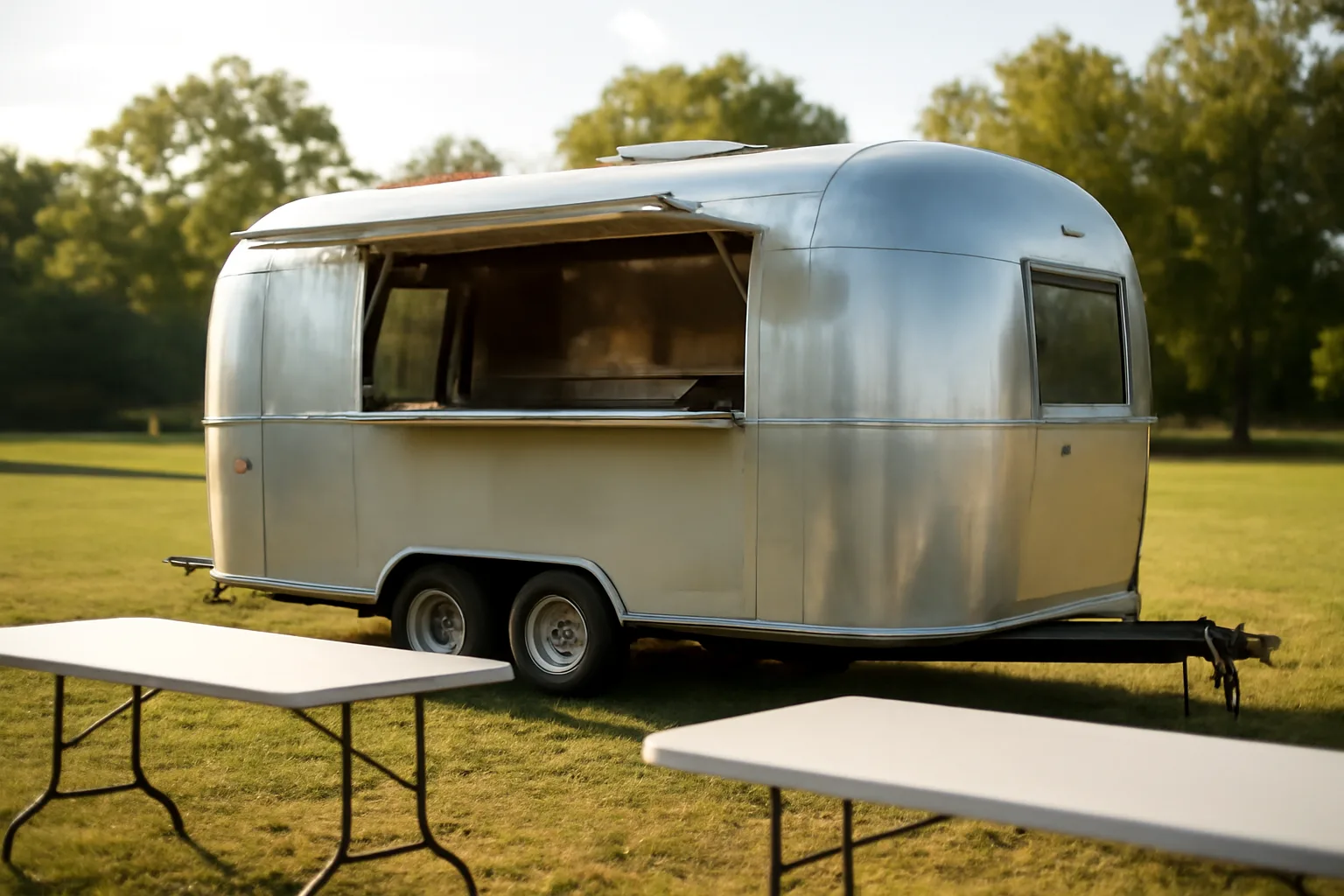
The trailer is the biggest line item, and the range is genuinely wide. A small used hot-dog-style trailer with a two-burner setup might clear a dealer lot or eBay for $8,000 to $15,000. A new mid-size trailer built for full-menu cooking, say 16 to 20 feet with a flat-top griddle, fryer, and exhaust hood, runs $25,000 to $50,000 from fabricators like Concession Nation. A large custom unit with a walk-in cooler, generator bay, and full Ansul fire suppression can push $70,000 to $90,000 or beyond. [1]
Those prices are for the trailer alone. You still have to equip it. A commercial griddle costs $800 to $2,500. A commercial fryer runs $600 to $2,000. A three-compartment sink (required by the Alabama Department of Public Health for mobile food units) adds $300 to $700, and a hand-wash sink is a separate requirement. [2] Budget $5,000 to $15,000 for smallwares, refrigeration, and the generator if the trailer does not include one.
Generator fuel is a recurring cost that catches new operators off guard. A 6,500-watt generator burns roughly 0.6 to 0.9 gallons of gasoline per hour at half load. At a twelve-hour event day and $3.50 per gallon, that's $25 to $38 per day in generator fuel alone, before propane for cooking.
The table in the next section lines up the most common configurations by size and price.
What does each trailer size and type actually cost?
| Trailer type | Typical length | New price range | Used price range |
|---|---|---|---|
| Basic vending / hot-dog cart trailer | 8-10 ft | $8,000, $15,000 | $3,500, $8,000 |
| Standard food trailer (griddle, fryer) | 14-16 ft | $20,000, $40,000 | $10,000, $22,000 |
| Full-menu food trailer (hood, 3-comp sink) | 18-24 ft | $35,000, $60,000 | $18,000, $35,000 |
| Large custom (walk-in, generator bay) | 24-32 ft | $60,000, $90,000+ | $30,000, $55,000 |
Sources: fabricator quote sheets from Concession Nation, Cruising Kitchens, and similar builders (2023-2024 pricing). [1] Steel prices move these numbers, so confirm current quotes directly with builders.
Used trailers save real money upfront. But health departments inspect equipment, more than the shell. A used unit may need a new grease trap, a hood recertification, or a fire suppression recharge before Alabama ADPH will approve it. Budget $1,000 to $4,000 for a used-unit compliance overhaul as a realistic line item, not a worst case.
Do you need a license for a concession trailer in Alabama?
Yes. Multiple licenses, actually. Alabama has no single unified mobile food vendor permit. You collect approvals from at least three separate agencies before your first service window opens.
First, the Alabama Department of Public Health issues a Mobile Food Unit permit under Alabama Administrative Code Chapter 420-3-22, which governs food service establishments including mobile units. [2] The permit fee depends on the risk category of your operation. Low-risk units (pre-packaged, no cooking) pay less than full-cooking units. Confirm the current fee directly with your county health department, because ADPH administers these locally and the dollar amount varies by county.
Second, you need a business license from the city or county where your trailer is based. Alabama Code Title 11, Chapter 51 authorizes municipalities to levy a privilege license on businesses operating within their limits. [3] Most Alabama cities charge $50 to $200 for a basic business license. Mobile vendors who cross into multiple jurisdictions face a choice: get licensed in each city you plan to work, or stick to unincorporated county areas. Jefferson County, Madison County, and Mobile County each run their own fee schedules.
Third, Alabama requires a sales tax account through the Alabama Department of Revenue if you sell taxable goods, and food prepared for immediate consumption is generally taxable in Alabama under Alabama Code Section 40-23-1. [4] Registration is free, but you must file monthly or quarterly returns depending on volume. [10]
Event-specific permits from parks, fairgrounds, or municipalities may layer on top. A county fair might require a $25 to $100 vendor permit on top of everything else. None of it is optional once organizers start checking documentation.
What does the Alabama ADPH mobile food unit permit process look like?
The ADPH path starts with a plan review before you operate. You submit your trailer's layout, equipment list, water supply method, and waste disposal plan to the county health department in the county where your commissary sits. Alabama Administrative Code 420-3-22 requires that mobile food units operate from an approved commissary or base of operations. [2]
A commissary is a licensed commercial kitchen where you prep food, store supplies, and dump gray water. Commissary agreements in Alabama typically cost $150 to $500 per month, depending on how much storage and prep access you need. Some charge a flat monthly fee; others charge by the hour of kitchen use. The county sanitarian inspects your commissary arrangement as part of the permit application.
After plan review approval, you get a pre-operational inspection. The inspector checks your three-compartment sink setup, food temperature controls, hand-washing facilities, and whether your fire suppression system (if your equipment requires one) carries a current tag. Pass that, pay the fee, and you get the permit. It's annual and requires a renewal inspection.
Processing times vary. Urban counties like Jefferson (Birmingham) and Madison (Huntsville) carry more application volume and sometimes take four to eight weeks from a complete submission. Rural counties can move faster, sometimes two to three weeks. Plan for six weeks in your pre-opening timeline and you'll rarely be caught short. Confirm current processing times with the specific county health department, because ADPH does not publish a statewide average.
How long does getting a concession trailer ready in Alabama take?
The honest answer is three to five months from "I want to do this" to your first legal service day, and that assumes no surprises. Here's where the time goes.
Building or buying the trailer takes four to twelve weeks if you order new. Custom fabricators are often booked eight to ten weeks out. A used trailer purchase can close in days, but used units almost always need some modification to meet current ADPH standards.
Commissary search and sign takes one to three weeks. You need a signed commissary agreement in hand before ADPH will accept your plan review application.
Plan review at the county health department takes two to four weeks after they receive a complete package. Incomplete submissions restart the clock.
The pre-operational inspection usually gets scheduled within one to two weeks of plan review approval, assuming you pass on the first visit.
Sales tax registration with the Department of Revenue is online and takes a few days. City and county business licenses are usually issued over the counter or within a week of application.
Total realistic timeline: 90 to 150 days. Operators who compress this by running steps in parallel (ordering the trailer while searching for a commissary while prepping plan review) can sometimes hit sixty to seventy days, but that needs everything to break right. Budget the longer timeline.
What does insurance cost for a concession trailer in Alabama?
You need at least two policies: commercial auto (the trailer is a vehicle under tow) and general liability (you're serving food to the public). Some event venues and fairs require a third, a vendor liability certificate naming the venue as an additional insured.
Commercial auto coverage for a food trailer in Alabama typically runs $800 to $1,800 per year. The premium tracks the trailer's value, your driving record, and whether you tow with a personal truck or a dedicated commercial vehicle.
General liability for a food vendor usually costs $500 to $1,500 per year for a $1 million per-occurrence policy. Food-specific liability adds a product liability component that covers claims if someone gets sick from your food. National carriers like Philadelphia Insurance and West Bend actively write food vendor policies and quote in this range, but get at least three quotes because premiums vary more than people expect.
If you use propane or run a deep fryer, some insurers add a fire-risk surcharge. That tacks on $200 to $500. The Alabama Department of Insurance publishes a list of licensed insurers in the state if you want to start with companies authorized to write Alabama policies. [5]
All-in annual insurance budget: $1,500 to $3,500 for a single-unit operator in Alabama.
What are the fire suppression and health code equipment requirements?
Alabama does not run a separate statewide fire code for mobile food units. Instead, the State Fire Marshal's office enforces NFPA 96 (Standard for Ventilation Control and Fire Protection of Commercial Cooking Operations) for cooking equipment under exhaust hoods. [6] If your trailer has a fryer, grill, or any open-flame cooking under a hood, NFPA 96 requires a listed fire suppression system, and that system needs a service tag from a licensed fire protection contractor showing it was inspected within the past twelve months.
Ansul R-102 and Pyro-Chem systems are the most common in food trailers. A new Ansul system installed by a contractor runs $1,500 to $3,000. Annual recertification (inspection plus any agent recharge if triggered) costs $150 to $400 from a licensed Alabama fire protection contractor.
ADPH inspectors check the suppression tag during your pre-operational inspection. An expired tag is a stop-sale finding. New operators buying used trailers often discover an expired tag the week before opening, so check the tag date before you close on any used purchase.
For operators sorting through the health and fire documentation, ConcessionPath's Health and Fire-Suppression Kit ($149 one-time) compiles the Alabama-relevant ADPH checklists and NFPA 96 compliance documentation into one package, which saves a few hours of hunting through agency websites.
A fire extinguisher rated at least 2A:10BC must also be mounted and accessible inside the trailer. That costs $30 to $80 at any hardware store. Don't skip it. Inspectors check.
What other startup costs should Alabama operators budget for?
The license-and-equipment checklist gets most of the attention, but first-year operators in Alabama consistently get surprised by a few other cost buckets.
Commissary fees for twelve months: $1,800 to $6,000, depending on the arrangement. This is an ongoing operating cost, not a one-time item.
Vehicle for towing: if you don't already own a half-ton or three-quarter-ton truck rated for your trailer's GVWR, add $15,000 to $45,000 for a used one. A loaded 24-foot trailer can weigh 12,000 to 15,000 pounds GVWR, so you need the right hitch class and tow rating.
Point-of-sale system: a basic Square setup is free on the first reader, but a fuller system with a cash drawer, receipt printer, and kitchen ticket printer runs $400 to $1,200 upfront.
Opening food inventory: plan for $800 to $3,000 depending on menu complexity.
Event permits and booth fees: fairs and festivals charge $100 to $1,000 per event for vendor space. Budget $2,000 to $5,000 for your first year of event fees if you're targeting the festival circuit.
Marketing materials, signage, and menu boards: $300 to $1,500 for a professional-looking setup.
Total first-year all-in budget for a new mid-size Alabama concession trailer operation: $30,000 to $75,000, covering the trailer, all licensing, commissary, insurance, a tow vehicle you already own, and event fees. That climbs to $80,000 to $120,000 if you're financing a new large trailer and need a tow vehicle.
How does Alabama compare to neighboring states for startup costs?
Alabama sits solidly mid-range compared to its neighbors. Florida has higher health department fees and often requires a separate Division of Hotels and Restaurants license on top of county permits, which adds cost. See how Florida's numbers stack up in our concession trailer cost in Florida breakdown. Georgia's permit structure matches Alabama's in complexity, but fees trend slightly higher in metro Atlanta counties.
Arkansas and Mississippi have lower overall permit costs but smaller festival and fair markets, which caps revenue opportunity. Our concession trailer cost in Arkansas article covers that comparison in detail.
For operators weighing multi-state operation, Alabama's sales tax structure (food prepared for immediate consumption is taxable at the standard 4% state rate plus local rates) is simpler than Georgia's, but you still hit the county-by-county business license issue. [4]
The cost structures for concession trailer operations in Georgia and in Illinois give useful benchmarks if you're deciding where to base your operation.
What financing options exist for Alabama concession trailer buyers?
Most Alabama concession trailer buyers finance through one of three paths.
Small Business Administration 7(a) loans cover equipment and working capital for food businesses. The SBA does not lend directly; you apply through an SBA-approved lender. Rates as of mid-2024 run prime plus 2.25% to 4.75% depending on loan size and term. [7] A full 7(a) approval takes six to twelve weeks, but SBA Express loans under $500,000 turn around in roughly thirty days.
Trailer-specific financing comes from many fabricators and some specialty lenders. Rates swing hard, from 6% for well-qualified buyers to 18% or higher for newer credit profiles. Terms of twenty-four to sixty months are common. Read the total cost of borrowing carefully: a $40,000 trailer financed at 15% over 48 months costs about $14,000 in interest.
The Alabama Small Business Development Center (SBDC) network offers free advising on financing and can connect you with local lenders. The network runs offices throughout the state. [8]
Personal savings and seller financing on used trailers are the cheapest options if you can get them. A private seller willing to carry a note at 5% to 8% over two years saves thousands compared to a commercial lender.
What's a realistic first-year revenue expectation for Alabama concession trailers?
Nobody has clean statewide data on Alabama concession trailer revenue, so this section is honest about the uncertainty.
Mobile food vendors face high failure rates in the first two years, consistent with food service broadly. The U.S. Bureau of Labor Statistics reports that roughly 17% of food service businesses close in year one and about 50% by year five. [9] Those are national figures. Alabama-specific data isn't separately published.
Anecdotally, operators at Alabama state fairs, college football tailgate circuits, and county fair events report gross revenue of $800 to $3,500 per event day depending on traffic and price point. A trailer working thirty to forty event days a year at an average of $1,500 gross per day pulls $45,000 to $60,000 in gross revenue before food cost (typically 28% to 35% of gross for a well-run operation), labor, fuel, event fees, and insurance.
The math is tighter than it looks. A $50,000 gross year at 30% food cost leaves $35,000 before everything else. After commissary ($3,000), insurance ($2,500), event fees ($3,000), fuel ($1,500), and loan payments on a financed trailer ($8,000 to $12,000), the operator might net $10,000 to $17,000 in year one. Profitable, but not retire-early money until the trailer is paid off.
Operators who own their trailer outright from day one, control food cost tightly, and build a repeat-venue circuit see meaningfully better outcomes. The equipment investment pays off. The financing cost is what grinds year-one margins.
Frequently asked questions
Do you need a license for a concession trailer in Alabama?
Yes. You need at minimum a Mobile Food Unit permit from the Alabama Department of Public Health (administered at the county level under Alabama Admin Code 420-3-22), a city or county business license under Alabama Code Title 11 Chapter 51, and a sales tax account with the Alabama Department of Revenue. Event-specific vendor permits from individual venues stack on top. Confirm current fees with your county health department because they vary.
How much does a concession trailer cost in Alabama?
A new concession trailer costs $15,000 to $90,000 depending on size and equipment. Used units start around $5,000 but usually need $1,000 to $4,000 in compliance upgrades to pass ADPH inspection. Add $5,000 to $15,000 for equipment not included in the trailer price. First-year all-in costs including licensing, commissary, and insurance typically run $30,000 to $120,000 depending on whether you finance.
How long does getting a concession trailer permit in Alabama take?
Plan for 90 to 150 days from your first step to your first legal service day. The biggest time consumers are finding and signing a commissary agreement (one to three weeks) and the ADPH county-level plan review (two to four weeks). Urban counties like Jefferson and Madison can take longer due to application volume. Confirm current processing times directly with your specific county health department; ADPH does not publish a statewide average.
What is a commissary and do Alabama food trailers require one?
A commissary is a licensed commercial kitchen where your trailer stores supplies, preps food, and disposes of wastewater. Alabama Administrative Code 420-3-22 requires mobile food units to operate from an approved commissary. You need a signed commissary agreement before ADPH will accept your plan review application. Expect to pay $150 to $500 per month depending on storage and prep access included in the agreement.
Is fire suppression required on Alabama concession trailers?
If your trailer has a fryer, grill, or open-flame cooking under an exhaust hood, yes. The Alabama State Fire Marshal enforces NFPA 96, which requires a listed fire suppression system under cooking hoods. The system needs an annual service tag from a licensed fire protection contractor. A new Ansul system runs $1,500 to $3,000 installed; annual recertification costs $150 to $400. ADPH inspectors check the tag date at your pre-operational inspection.
Do I need separate licenses if I operate in multiple Alabama cities?
Generally yes. Alabama Code Title 11 Chapter 51 authorizes each municipality to levy its own privilege license on businesses operating within city limits. If you vend regularly in Birmingham, Huntsville, and Mobile, each city can require its own business license. Some operators focus on unincorporated county areas to reduce license stacking. Check with each city's revenue or licensing office for their specific mobile vendor requirements.
Is food sold from a concession trailer taxable in Alabama?
Yes. Prepared food sold for immediate consumption is subject to Alabama sales tax under Alabama Code Section 40-23-1. The state rate is 4% plus applicable county and municipal rates, which can push the combined rate to 9% or higher in some jurisdictions. You must register for a sales tax account with the Alabama Department of Revenue before you open, and file returns monthly or quarterly based on your sales volume.
What insurance does an Alabama concession trailer operator need?
At minimum: commercial auto coverage for the trailer while it's being towed ($800 to $1,800 per year) and general liability with product liability coverage ($500 to $1,500 per year for a $1 million policy). Many events and venues require a certificate naming them as additional insured. Operators with fryers or propane equipment often pay a fire-risk surcharge of $200 to $500. Budget $1,500 to $3,500 annually for a single-unit operation.
Can I buy a used concession trailer in Alabama and use it right away?
Not immediately. A used trailer needs to pass an ADPH pre-operational inspection before you can legally serve food. Common issues with used units include expired fire suppression tags, non-compliant sink configurations, and missing handwash sinks. Budget $1,000 to $4,000 for compliance upgrades on a used trailer. Check the suppression system tag date and the three-compartment sink setup before you close on any purchase.
How much does a commissary agreement cost in Alabama?
Commissary agreements in Alabama typically run $150 to $500 per month depending on what's included: storage space, prep kitchen access, and wastewater disposal. Some commissaries charge a flat monthly fee; others charge hourly for kitchen use. Annual commissary cost ranges from roughly $1,800 to $6,000. You need a signed agreement before submitting your ADPH plan review application, so find your commissary early in the process.
What equipment does Alabama ADPH require in a food trailer?
Alabama Administrative Code 420-3-22 requires a three-compartment sink for washing, rinsing, and sanitizing equipment, a separate handwashing sink, adequate refrigeration to hold cold food at 41°F or below, and proper wastewater containment. If you cook under an exhaust hood, a fire suppression system is required under NFPA 96. A 2A:10BC fire extinguisher must be mounted and accessible. Your county sanitarian reviews the specific equipment list during plan review.
How do I find a commissary for my concession trailer in Alabama?
Start by calling your county health department and asking if they keep a list of approved commissaries. Restaurant owners, church kitchens, and catering companies sometimes rent commissary time. The Alabama Restaurant and Hospitality Association may also have referrals. Expect to show the commissary's own health permit to the county sanitarian as part of your mobile unit plan review package. Some areas have dedicated commissary facilities for food truck operators.
Does Alabama have a state-level mobile food vendor license separate from the county permit?
No. Alabama does not have a single statewide mobile food vendor license. The ADPH mobile food unit permit is issued at the county level and is the primary health permit, but it does not substitute for city business licenses, sales tax registration, or event-specific vendor permits. Each jurisdiction you operate in may have its own requirements. Confirm with both your county health department and any city or county where you plan to vend regularly.
Sources
- Concession Nation, Trailer Pricing Page: New food trailer price ranges by size and configuration, $15,000 to $90,000+
- Alabama Department of Public Health, Alabama Admin Code 420-3-22, Mobile Food Units: ADPH requires mobile food units to operate from an approved commissary and meet equipment standards including three-compartment sink and handwashing sink
- Alabama Legislature, Code of Alabama Title 11, Chapter 51 (Municipal License Taxes): Alabama municipalities are authorized to levy privilege licenses on businesses operating within city limits under Title 11 Chapter 51
- Alabama Legislature, Code of Alabama Section 40-23-1 (Sales Tax, Definitions and Levy): Prepared food sold for immediate consumption is subject to Alabama sales tax at the 4% state rate plus local rates
- Alabama Department of Insurance, Licensed Companies: The Alabama Department of Insurance publishes a list of insurers licensed to write policies in the state
- National Fire Protection Association, NFPA 96: NFPA 96 requires a listed fire suppression system for commercial cooking equipment under exhaust hoods
- U.S. Small Business Administration, 7(a) Loan Program: SBA 7(a) loans cover equipment and working capital for small food businesses; rates are prime plus 2.25% to 4.75% depending on loan size and term
- Alabama SBDC Network, University of Alabama: Alabama Small Business Development Center network offers free business advising and financing connections statewide
- U.S. Bureau of Labor Statistics, Business Employment Dynamics, Survival of Private Sector Establishments: Approximately 17% of food service businesses close in year one and roughly 50% by year five based on BLS business survival data
- Alabama Department of Revenue, Sales and Use Tax Registration: Alabama requires sellers of taxable goods including prepared food to register for a sales tax account with the Department of Revenue before first sale