Last updated 2026-08-17
TL;DR
A new concession trailer in Alaska runs $20,000 to $120,000 depending on size and equipment. Add $500 to $2,000 in state and municipal licensing, a certified fire suppression system ($1,500 to $3,500), and a commissary agreement. Plan for higher freight and propane costs than the lower 48. Total first-year spend typically lands between $35,000 and $150,000.
What does a concession trailer cost in Alaska?
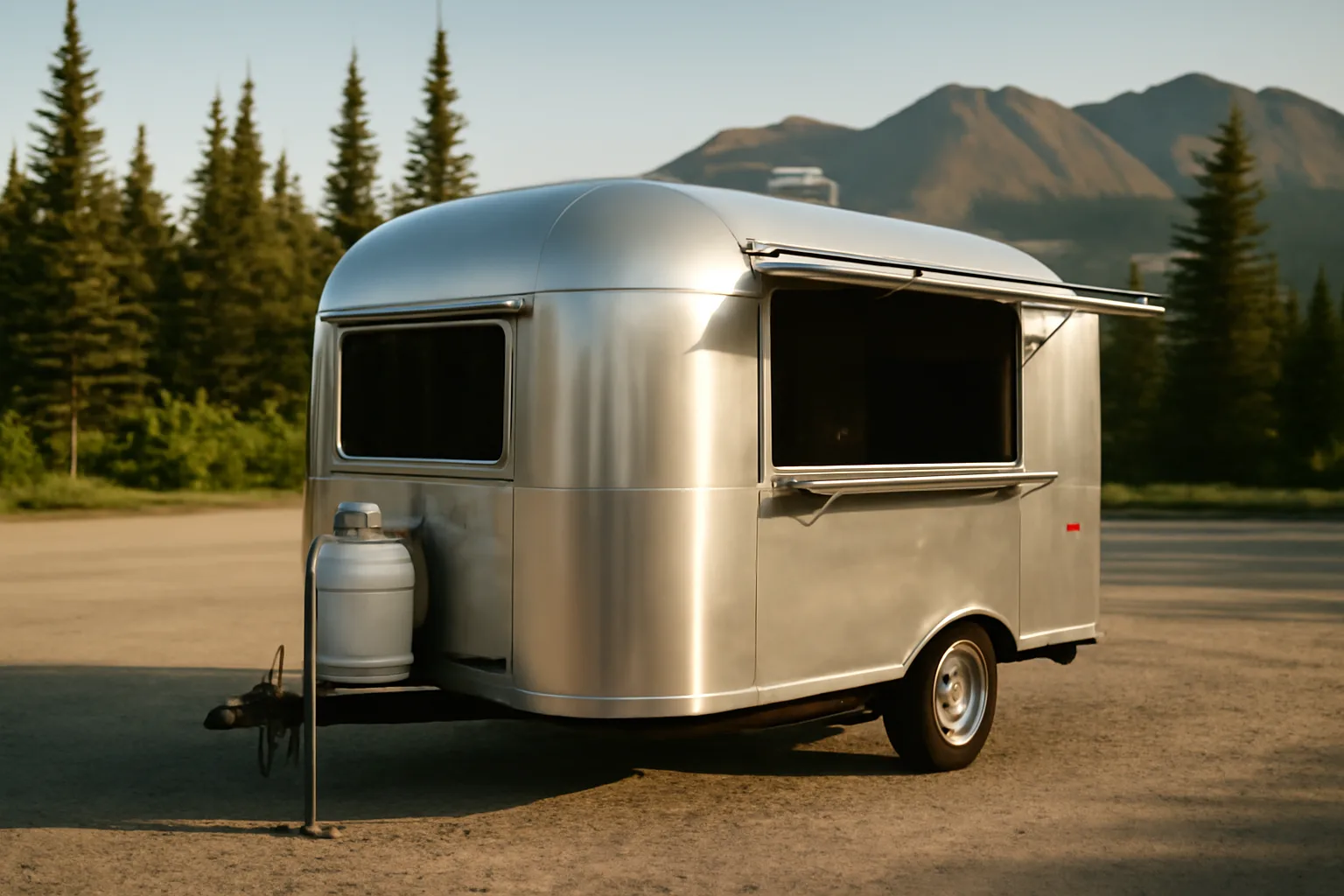
The trailer is your biggest line item, and Alaska makes it cost more than almost anywhere in the country. A basic 8-foot by 14-foot single-axle unit from a builder in Texas or the Midwest lists for $20,000 to $40,000 before you bolt in a single fryer. A mid-range 20-foot to 24-foot trailer with a commercial hood, fryers, and a flat-top runs $50,000 to $85,000. A fully loaded 28-foot or 32-foot unit with a walk-in cooler, a three-compartment sink, and a full kitchen can push past $120,000. [1]
Then Alaska adds a freight penalty on top. Most builders ship from the continental U.S., and getting a trailer to Anchorage or Fairbanks by road through Canada or by barge into Southeast adds $2,000 to $8,000, depending on route and season. [2] Some buyers tow it up the Alaska-Canada Highway themselves to skip the shipping fee. That is a 1,400-mile haul through mountain passes and gravel stretches, so price out the wear on your tow vehicle before you call it the cheaper move.
Used trailers exist here, but the market is thin. You will find a handful listed on Facebook Marketplace or Craigslist Anchorage at any given time, usually $15,000 to $45,000 for units that need inspection and maybe fresh fire suppression. Budget $500 to $1,500 for a pre-purchase inspection from an NFPA-trained technician before you commit to any used unit. [3]
The table below breaks down what you actually get at each price tier.
How does Alaska's trailer cost compare to nearby states?
| Trailer tier | Lower 48 typical range | Alaska delivered estimate |
|---|---|---|
| Basic (14 ft) | $18,000, $35,000 | $22,000, $43,000 |
| Mid-range (20-24 ft) | $45,000, $75,000 | $50,000, $85,000 |
| Full commercial (28-32 ft) | $80,000, $110,000 | $90,000, $125,000 |
| Used (any size) | $10,000, $40,000 | $15,000, $45,000 |
The gap is almost entirely freight plus a smaller used market. Idaho buyers face similar terrain but no ocean crossing and no Alaska Highway haul, so their delivered prices stay closer to manufacturer list. See how Idaho's numbers stack up at concession trailer cost in Idaho, and Hawaii is the only state with logistics costs in the same league or higher, detailed at concession trailer cost in Hawaii.
Propane gets its own line. Alaska propane swings hard, and the U.S. Energy Information Administration tracks it regionally. In recent winters, Alaska residential propane has averaged $3.50 to $5.00 per gallon against a national average closer to $2.50. [4] A trailer running a fryer, griddle, and burners through a busy festival day can burn 15 to 25 gallons. That compounds across a 90-day summer fast.
Do you need a license for a concession trailer in Alaska?
Yes. Every mobile food unit in Alaska needs a food establishment permit from the Alaska Department of Environmental Conservation (DEC), Division of Environmental Health, and an inspection before that permit issues. DEC treats mobile units as their own permit class. Its guidance requires mobile food establishments to meet 18 AAC 31, Alaska's food code, which covers construction, equipment, and sanitation. [5]
The DEC permit fee for a mobile food establishment falls in the range of $200 to $400 per year, but fees are set by regulation and can change, so confirm the current amount directly with DEC's Environmental Health program. [5] The permit is not transferable between owners. A used trailer does not come with a ready-to-use permit.
You also need a business license from the Alaska Department of Commerce, Community, and Economic Development. The standard license costs $50 for a two-year term. [6] That is one of the cheapest business licenses in the country, and you file it online.
Most municipalities stack their own rules on top. Anchorage makes a mobile food unit get a municipal business license and pass a municipal Environmental Health inspection. Anchorage Municipal Code Chapter 16.60 governs mobile food vendors, including where they can operate and how far they must sit from brick-and-mortar restaurants. [7] Fairbanks, Juneau, and other municipalities run their own versions. Call the local planning or environmental health office before you lock in an operating location.
A state business license, a DEC food permit, and a city or borough operating permit are the three-layer minimum for almost every Alaska concession operator. Some events also require a temporary food establishment permit for a single appearance on top of your annual permit, so read the vendor packet carefully before every fair or festival.
What fire suppression and health inspection requirements apply in Alaska?
Alaska's food code under 18 AAC 31 requires mobile food units to meet sanitation and safety standards, and any trailer with open-flame cooking under a hood must carry a listed fire suppression system. [5] The National Fire Protection Association standard NFPA 96 governs commercial kitchen fire suppression, and Alaska fire marshals enforce it under the state fire code. [3]
A new Ansul or equivalent wet-chemical system installed on a trailer runs $1,500 to $3,500 depending on how many appliances it protects. Annual inspection and recharge certification runs $150 to $350 from a licensed technician. [3] This is not optional, and it is not a corner to cut. An uncertified system can get your permit denied and, if you ever file a claim, void your liability coverage.
DEC inspectors check plumbing, water tank capacity, the three-compartment sink setup, the handwashing station, temperature-holding equipment, and waste disposal before they issue a permit. If you are building out a trailer from scratch or modifying an existing one, get DEC's pre-operational checklist before construction so you do not build something that fails on sink depth or tank size. [5]
ConcessionPath's Health and Fire-Suppression Kit ($149 one-time) bundles the DEC checklist requirements with NFPA 96 suppression documentation into one packet, which some operators find handy when briefing a contractor on what the finished trailer has to pass. Find it at /start.
How much does a commissary agreement cost in Alaska?
Alaska, like most states, requires mobile food units to work out of a licensed commissary, a fixed commercial kitchen where you store product, wash equipment, and prep the food that cannot happen inside the trailer. DEC enforces this under 18 AAC 31. [5]
Commissary rent in Alaska runs above the national average, partly because commercial kitchen space is scarce outside Anchorage. Expect $200 to $600 per month for a commissary agreement in Anchorage. In Fairbanks or Juneau the options thin out, and some operators report $400 to $800 per month or more, if they can find space at all. [2] A few operators in remote areas have built their own licensed prep kitchens, which adds capital cost but solves the availability problem.
Get your commissary agreement in writing before you apply for the DEC permit. The inspection application usually requires proof of commissary access. Without it, your file sits incomplete.
How much does insurance cost for an Alaska concession trailer?
General liability for a food concession trailer in Alaska runs $800 to $2,500 per year on a $1 million per-occurrence policy. The range reflects what you cook (deep-frying rates higher than cold-serve), whether you have employees, and your revenue. [2]
Commercial auto on the trailer itself, which covers it in transit, typically adds $600 to $1,400 per year depending on how often you tow and your driving record. Park the trailer seasonally and skip the towing, and some insurers offer a storage rider that cuts the premium through winter, which matters in a state where a six-month operating season is common.
Many festival and market organizers in Alaska require vendors to carry a $1 million general liability policy and name the organizer as an additional insured. Read the vendor agreement before you buy so the limits and endorsements match what the event demands.
For a look at startup costs in warmer markets, concession trailer cost in Florida and concession trailer cost in California show how insurance and licensing shift in year-round states.
How long does it take to get a concession trailer licensed in Alaska?
Plan for eight to sixteen weeks from application to operational permit, and longer if any inspection fails or needs a reinspection. That is not a guarantee. It reflects what DEC's processing workloads and scheduling actually produce, so confirm current timelines with DEC before you set an opening date. [5]
The bottleneck most new operators hit is DEC inspection scheduling, not the paperwork. Inspectors cover big territory, and if your trailer sits in Fairbanks or a rural community, the wait for an in-person slot can be four to eight weeks on its own. Some operators in remote areas tow to Anchorage for the inspection rather than wait for a field inspector to travel.
The Alaska business license from the Department of Commerce processes in roughly ten business days online. [6] Municipal permits vary. Anchorage's Environmental Health office typically takes two to four weeks from a complete application. [7]
Here is a realistic timeline if everything goes right:
| Step | Estimated time |
|---|---|
| State business license | 10 business days |
| DEC permit application review | 2 to 4 weeks |
| DEC inspection scheduled and completed | 2 to 8 weeks |
| Municipal license and inspection | 2 to 4 weeks |
| Commissary agreement in place | As soon as you find space |
| Total, from first application | 8 to 16 weeks |
Start the paperwork before the trailer arrives, not after. Operators who wait until the unit is parked in the driveway routinely lose the first month of the season to processing.
What are the real first-year operating costs for a concession trailer in Alaska?
After the trailer purchase, first-year costs stack up faster than most new operators expect. Here is a realistic first-year budget for a mid-range 20-foot trailer running a 90-day summer season in Alaska:
| Cost category | Estimated range |
|---|---|
| Trailer (financed or paid) | $50,000, $85,000 |
| Freight / delivery | $2,000, $8,000 |
| DEC food permit | $200, $400 |
| State business license | $50 |
| Municipal permits | $100, $500 |
| Fire suppression (new install) | $1,500, $3,500 |
| Commissary (8 months) | $1,600, $6,400 |
| General liability insurance | $800, $2,500 |
| Commercial auto insurance | $600, $1,400 |
| Initial food inventory | $2,000, $6,000 |
| Propane (90-day season) | $2,000, $6,000 |
| Event fees / booth rentals | $1,500, $5,000 |
| Miscellaneous supplies | $500, $1,500 |
| Total first year | $62,850, $126,250 |
That top end assumes you bought a trailer outright at the high tier. Finance instead, swap the purchase line for a down payment and a monthly note, and the year-one cash requirement drops hard while total cost over the loan term rises.
Alaska's short season is the variable that makes or breaks the math. A trailer in Florida or California can run 10 to 12 months a year. Alaska's summer festival circuit runs roughly May through September in most of the state, with shoulder-season farmers markets in Anchorage. Spread fixed costs across 90 to 120 active days, and each day has to earn more to cover the same annual overhead. Build your break-even model on 90 operating days before you commit to any trailer price.
concession trailer cost in Colorado and concession trailer cost in Idaho are useful comparisons for mountain-state operators with similar shoulder-season limits.
What equipment inside the trailer is required or most expensive in Alaska?
Alaska's DEC food code requires, at minimum, a three-compartment sink, a separate handwashing sink, an approved water supply (fresh water tank or direct hookup), and a wastewater tank or approved drain. [5] Those are the non-negotiable structural pieces, and they go in before the DEC inspection.
Past those minimums, your cooking equipment drives both cost and fire suppression complexity. A single commercial fryer runs $1,500 to $5,000. A commercial flat-top griddle runs $1,000 to $4,000. A commercial six-burner range runs $2,000 to $6,000. Stack multiple appliances under one hood and you need a bigger suppression system, which adds cost. [1]
Refrigeration is expensive in a trailer and worse in Alaska, where ambient temperatures swing wide. A compressor-based undercounter refrigerator built for a trailer runs $800 to $2,500. Some operators lean on the cold weather for storage. Do not use outdoor ambient temperature as a substitute for a certified refrigeration unit. DEC inspectors will fail that setup.
Generator cost is real if you lack consistent shore power at your locations. A commercial-grade diesel or propane generator rated 7,500 to 12,000 watts, enough for a full kitchen, runs $3,000 to $8,000 new. Fuel for a generator running full days adds another $20 to $50 per day at Alaska diesel prices.
One opinion, stated plainly: do not overbuild for Alaska's market size. A $120,000 fully loaded unit is hard to justify when your seasonal revenue ceiling is capped by how many events the state actually holds. Start with a well-built mid-range unit, prove the concept, then upgrade.
Can you operate a concession trailer in remote or rural Alaska?
Yes, but the logistics and the regulatory path get harder fast. Many remote Alaska communities sit in unorganized boroughs, meaning no local municipality issues permits. In those areas the DEC permit and the state business license are the primary requirements, and you deal directly with DEC's regional office. [5]
The practical problem is supply. Bringing food inventory into a remote community by small plane, barge, or snow machine adds real cost per pound. Propane delivery can take weeks of advance planning. Many remote operators run limited menus built on long shelf-life ingredients to cut resupply trips.
Inspection logistics are the other wall. Getting a DEC inspector to a remote location can mean a long wait or, for the far-out sites, a plan to bring the trailer to an accessible spot for inspection. Talk to DEC's regional office early if you plan to operate off the road system.
For operators eyeing Pacific Northwest markets before or after an Alaska season, concession trailer cost in Idaho and concession trailer cost in Colorado cover the seasonal mountain market dynamic.
Where to apply and who to call in Alaska
These are the actual offices and pages you need, not general agency homepages:
Alaska DEC, Division of Environmental Health, food program: handles the mobile food establishment permit application, inspection scheduling, and commissary requirements. Its food safety program page covers 18 AAC 31 and the application process. [5]
Alaska Department of Commerce, Community, and Economic Development: issues the state business license online for $50 per two-year term. [6]
Anchorage Department of Health, Environmental Health: handles municipal food permits and Anchorage Municipal Code Chapter 16.60 compliance for operators based in or working in Anchorage. [7]
Alaska State Fire Marshal: oversees fire code compliance, including NFPA 96 suppression requirements, through the Department of Public Safety. [3]
Operators who want DEC's and NFPA's full requirements in one place can use ConcessionPath's Health and Fire-Suppression Kit at /start, which covers both documents. It does not replace direct contact with these agencies. It organizes the requirements before you start calling.
Start with DEC. Their pre-operational checklist tells you what to build. Build that, then schedule the inspection. Everything else follows from there.
Frequently asked questions
How much does a concession trailer cost in Alaska?
A basic 14-foot trailer delivered to Alaska runs $22,000 to $43,000. A mid-range 20-to-24-foot unit with commercial cooking equipment costs $50,000 to $85,000 delivered. A full commercial 28-to-32-foot trailer can reach $125,000. Add $2,000 to $8,000 for freight from the lower 48, which is the biggest cost difference versus other states.
Do you need a license for a concession trailer in Alaska?
Yes. You need three things at minimum: a state business license from the Alaska Department of Commerce ($50 for two years), a mobile food establishment permit from Alaska DEC (roughly $200 to $400 per year, confirm current fee with DEC), and a municipal permit from your city or borough. Most municipalities also require their own environmental health inspection before they issue a local operating permit.
How long does it take to get a concession trailer permitted in Alaska?
Plan for eight to sixteen weeks total from first application to operational permit. The DEC inspection is the longest step, especially outside Anchorage, where inspector travel can add four to eight weeks to scheduling. The state business license processes in about ten business days. Start paperwork before your trailer arrives so you do not lose the first weeks of the season to processing time.
Is a commissary required for a concession trailer in Alaska?
Yes. Alaska DEC requires mobile food units to operate from a licensed commissary for product storage, equipment washing, and prep work. In Anchorage, commissary space runs $200 to $600 per month. In Fairbanks or Juneau, where space is scarcer, expect $400 to $800 or more. You must have a signed commissary agreement before DEC will complete your permit application.
What fire suppression system does a concession trailer need in Alaska?
Any trailer with open-flame cooking under a hood needs a listed wet-chemical fire suppression system meeting NFPA 96. A new Ansul or equivalent system installed on a trailer runs $1,500 to $3,500. Annual inspection and certification costs $150 to $350. Alaska fire marshals enforce this under the state fire code, and an uncertified system will result in permit denial.
How much does insurance cost for an Alaska concession trailer?
General liability insurance runs $800 to $2,500 per year for a $1 million per-occurrence policy, depending on food type and revenue. Commercial auto on the trailer adds $600 to $1,400 per year. Most Alaska festival organizers require $1 million in general liability with the organizer named as an additional insured, so confirm event requirements before buying a policy.
What is the Alaska DEC food permit for a mobile unit?
The Alaska Department of Environmental Conservation issues a mobile food establishment permit under 18 AAC 31, Alaska's food code. The permit requires a pre-operational inspection covering equipment, plumbing, handwashing setup, water and waste tank capacity, and sanitation standards. Fees run approximately $200 to $400 per year; confirm current amounts with DEC's Division of Environmental Health directly.
Can I buy a used concession trailer in Alaska?
Yes, but the market is thin. You will typically find a handful of listings at any given time on Facebook Marketplace or Craigslist Anchorage, priced $15,000 to $45,000. Budget $500 to $1,500 for a pre-purchase inspection by an NFPA-trained technician. A used trailer does not transfer the previous owner's DEC permit; you apply for a new permit and the unit must pass a fresh inspection.
How much does propane cost for a concession trailer in Alaska?
Alaska propane prices have averaged $3.50 to $5.00 per gallon in recent years, compared to a national average closer to $2.50 according to U.S. Energy Information Administration regional data. A trailer running a full kitchen for a busy day can burn 15 to 25 gallons. Over a 90-day summer season, propane costs can total $2,000 to $6,000 depending on menu and volume.
How does Alaska's short season affect concession trailer profitability?
Alaska's outdoor concession season runs roughly May through September in most of the state, or about 90 to 120 operating days. Fixed costs like insurance, permits, and commissary rent still accumulate year-round or through the off-season. That means each operating day must generate significantly more revenue than in a year-round-climate state to cover the same annual overhead. Build your break-even model on 90 days before committing to any trailer price.
Do rural or remote Alaska locations have different licensing rules?
In unorganized boroughs with no local municipality, the DEC food permit and state business license are the primary requirements, and there is no local municipal layer. The practical challenge is inspection logistics: getting a DEC inspector to a remote location can take weeks or require you to bring the trailer to a road-accessible site. Contact DEC's regional office early if you plan to operate outside a road-connected community.
What equipment is required inside an Alaska concession trailer by DEC?
Alaska's 18 AAC 31 food code requires a three-compartment sink, a separate handwashing sink, an approved fresh water supply, and a wastewater tank or drain. Any open-flame cooking under a hood requires a certified fire suppression system. Refrigeration must be mechanical and certified; using outdoor ambient temperature as cold storage does not pass DEC inspection.
How much does a generator cost for a concession trailer in Alaska?
A commercial-grade diesel or propane generator rated 7,500 to 12,000 watts, enough to run a full kitchen, costs $3,000 to $8,000 new. At Alaska diesel prices, fuel for a generator running a full operating day runs $20 to $50 per day. Operators with consistent shore power at their locations avoid this cost entirely, so vet your event locations for electrical access before buying.
Where do I apply for a concession trailer permit in Alaska?
Start with Alaska DEC's Division of Environmental Health for the food establishment permit. Get the state business license from the Alaska Department of Commerce online. Then contact your city or borough health office for local permits: Anchorage uses its Department of Health Environmental Health division, governed by Municipal Code Chapter 16.60. Call DEC first; their pre-operational checklist tells you what to build before any other agency gets involved.
Sources
- U.S. Small Business Administration, Fund your business (equipment and startup cost guidance): New concession trailer and equipment costs are a major startup line item, with commercial cooking equipment adding thousands per appliance
- Alaska Small Business Development Center: Higher freight, commissary scarcity, and propane costs for mobile food businesses in Alaska versus the lower 48
- NFPA 96, Standard for Ventilation Control and Fire Protection of Commercial Cooking Operations: Commercial kitchen trailers with open-flame cooking under a hood must have a listed wet-chemical fire suppression system meeting NFPA 96
- U.S. Energy Information Administration, Alaska Propane Retail Prices: Alaska propane retail prices have averaged $3.50 to $5.00 per gallon in recent years versus a national average closer to $2.50
- Alaska Department of Environmental Conservation, Food Safety and Sanitation Program, permits: DEC requires a food establishment permit and pre-operational inspection for all mobile food units under 18 AAC 31; commissary agreement required before permit issues
- Alaska Department of Commerce, Community, and Economic Development, Business License program: Alaska state business license costs $50 for a two-year term and is available online
- Anchorage Municipal Code, Chapter 16.60, Mobile Food Vendors: Anchorage requires mobile food vendors to comply with Chapter 16.60 governing operating locations and distance rules from brick-and-mortar restaurants